OpenVLA: An Open-Source Vision-Language-Action Model
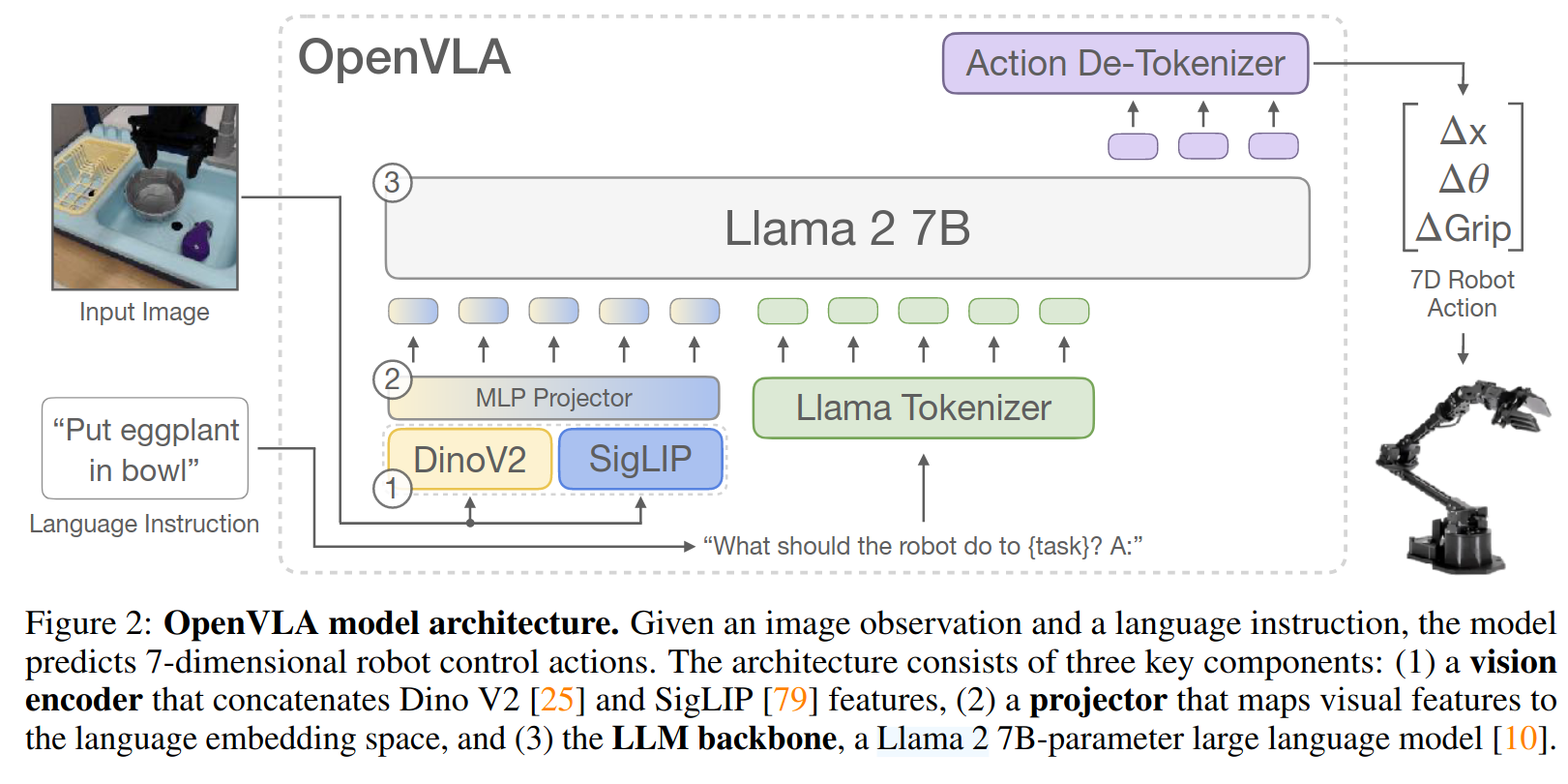 本质上来说,OpenVLA其实没有多余的action expert,基本上完全依靠其VLM了。同时它也没有像pi0那种针对robot data的pre-training和post-training
De-Tokenizer:
这篇文章没有使用后来流行的扩散模型直接生成action,而是输出离散的action token。那么这其实也意味着几件事:
- 需要预先对output space进行统计并分成256 bin:
For each action dimension, we set the bin width to uniformly divide the interval between the 1st and 99th quantile of the actions in the training data
- Llama2 的vocabulary大小为32000,使用subword tokenization可以handle大部分文本内容了,但是只预留了100个empty tokens (e.g.,
<reserved_1>…),这些token在原先model中没有具体意义。那么对于这里的256 bin,100个是不够的。作者的做法很有趣,就是用31744-31999,也就是改变最不常用的256个token当成action的语义来使用。 - Llama是可以输出不定长结果的,如何保证它一定输出7个output token呢?
- 在训练过程中,强制7个输出并一一对应,以
<EOS>token结尾; - 在inference阶段设置其自回归
max_new_tokens = 7Inference
这篇文章是single-step prediction,也就是每次只预测下一步的内容。作者用了quantization进行加速,最终在4090上能有一个6Hz的推理速度。
Takeaway
However, we found fine-tuning the vision encoder during VLA training to be crucial for good VLA performance
- 在训练过程中,强制7个输出并一一对应,以
说明对于VLA而言,Vision信号是一个非常重要的因素